Sunday, May 15, 2016

2016 Kojak Lalanne Eight Calisthenics Routine

Your comments on the following are welcomed.

Current Kojak LaLanne Eight Bodyweight Exercise Routine:

Resistance:
Squats
Rear Lunges (alternate leg)
Dips
Pull Ups
Push Ups
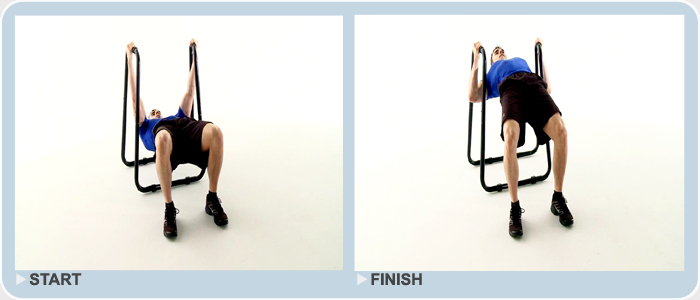
Inverted Rows
Planks

Cardio:
Jump Rope
Bicycle

Images:


Saturday, April 12, 2014

Strength training or cardio?


A good workout depends on more than just the right exercises. It also means doing them in the right order. After all, no exercise is performed in a vacuum. Every move you make affects the ones that come after it and, ultimately, your results, says fitness expert Ashley Borden, who has trained the likes of Ryan Gosling and MLB player Nick Swisher.

Borden's advice: Do your strength training before you even look at a piece of cardio equipment. Why? If you tucker yourself out on the treadmill, you're going to have trouble eking out reps in the weight room. When you're tired, your form suffers, and the last place you want to be struggling with your hip positioning is under a heavy barbell, she says. Plus, strength training is what really builds muscle and burns the most calories over the long term.

That's not to say strength training doesn't sap your energy—it does—but it primarily uses your anaerobic system, which burns carbs for energy, while your aerobic system can burn either carbs or fat to fuel lower-intensity, longer-duration exercise. So if you're out of carbs by the time you get to your cardio, you'll burn through fat before your form has a chance to waver. (Learn how to burn the most calories from both carbs and fat.)

Similar logic follows when it comes to the order of your strength moves. "You always want to hit your major muscle groups first. For example, push-ups followed by skull crushers or lat pull-downs followed by standing biceps curls," Borden says. "You don't want to fatigue your smaller muscles first and deplete your big-muscle-group strength."


http://www.foxnews.com/health/2014/04/10/why-workout-order-matters/?intcmp=obnetwork

Saturday, December 7, 2013

Cardio or Strength Training?

 
Women lifting weights.jpg

The question: To lose weight, should I spend my gym time doing more cardio or more strength training?

The expert: Personal trainer Mike Donavanik, C.S.C.S., C.P.T.

The answer: It depends what you mean by "lose weight." If you are in an epic battle with your scale, cardio is the way to go. If you want to look steamy under those fall sweaters, though, it's time to cozy up to strength training.

Minute per minute, cardio indisputably burns more calories than strength training, which could explain why compared to strength trainers, aerobic exercisers lose more weight in less time, according to a recent Duke University study.

Still, cardio doesn't do much for your muscles. Case in point: In one Penn State study, dieters lost 21 pounds whether they performed cardio or strength training. But for the cardio group, six of those pounds came from muscle, while the lifters lost almost pure fat—and probably fit into their skinny jeans better because of it.

Why? Strength training is the number-one way to build more muscle. And for every three pounds of muscle you gain, you can expect to burn an extra 120 calories a day without moving a single one of those muscles, says Donavanik.

That doesn't mean that you should retire your running shoes, though—especially if you're a stress eater. Cardio is one of the best ways to slash stress, which is a waistline-wrecker all by itself. The best solution? A fitness plan that includes both cardio and strength training. So check out how to your improve your strength-training routine and your learn how to fix your cardio workout mistakes.

Friday, December 6, 2013

Work out like a supermodel

Get toned the same way Victoria's Secret angels Adriana Lima and Doutzen Kroes do with this workout by model trainer Michael Olajide Jr.
What: Getting toned the same way Victoria's Secret angels Adriana Lima and Doutzen Kroes (center left) do it. They owe their defined, jaw-dropping curves to Olajide's fat-melting, muscle-sculpting moves.
Grab: A jump rope and a 10-pound body bar
How: Your wing-worthy figure takes 3 sets of each move three times a week (alternating days).

  • 1Rope ‘em in

    Self.com
    Stand with feet together, knees soft, elbows bent 90 degrees, holding jump rope handles with rope behind you. Jump over rope slowly, landing in a squat each time (as shown). Continue for 1 minute.

    Works abs, butt, thighs, calves
    Related: 20 Superfoods For Weight Loss
  • 2Take flight

    Self.com
    Start in a deep squat with feet wider than hip-width apart, toes out, fingertips on floor between feet. Explode up onto balls of feet, extending arms overhead with palms forward, legs wide (as shown). Jump back to start. Repeat for 1 minute.

    Works butt, thighs, calves
    Related: 5 Ways to Burn 500 Calories
  • 3Picture-perfect punch

    Self.com
    Stand with feet slightly wider than hip-width apart, knees soft, elbows bent, hands in fists in front of face. Punch right arm forward (as shown). Switch sides; repeat. Move slowly at first, then pick up the pace, alternating punches for 2 minutes.

    Works, shoulders, arms, back, abs
  • 4Hot-body bar

    Self.com
    Stand with feet wider than hip-width apart. Hold bar with both hands in an overhand grip, palms at center, elbows bent and resting on top of bar, arms parallel to floor. Tilt to right so upper body is parallel to floor (as shown). Return to start. Switch sides; repeat. Continue for 1 minute.

    Works shoulders, back, obliques
    Related: 6 Moves To Resize Your Butt and Thighs
  • 5Catwalk cross

    Self.com
    Stand with feet together, knees soft, elbows bent 90 degrees, holding jump rope handles with rope behind you. Swing rope overhead, then cross arms in front of body and jump over rope (as shown). Continue for 3 minutes.
    This article originally appeared on Self.com

Saturday, August 18, 2012

Naval Aviator Develops Jump Rope

The CrossRope system, invented by Navy pilot Lt. David Hunt,
features seven interchangeable ropes of varying weights,
all designed for different workouts.

by Jacqueline Klimas: Naval Aviator’s jump rope gives better workout. Lieutenant’s invention turns simple skips into a portable fitness program

These aren’t your middle school jump ropes. The CrossRope system, invented by Navy pilot Lt. David Hunt, features seven interchangeable ropes of varying weights, all designed for different workouts.

Lighter weights can be used for cardio or speed training, while the heavier weights are used for strength or building muscle, said Hunt, an aviator assigned to Patrol Squadron 30 at Naval Air Station Jacksonville, Fla. The handles have snaps for swapping between ropes.

Hunt came up with the idea for the CrossRope system in 2011 because of his own experience as a jump-roper.

“I liked to try a bunch of different weights, but there wasn’t one product to offer multiple weights,” he said.

Hunt, 30, launched the small business with the help of friends and colleagues, even filing the provisional patent application himself. His invention is still patent-pending.

The aviator, who flies the P-3C Orion and has served in Iraq, Qatar, Djibouti and Bahrain, is confident CrossRope will catch on with sailors.

“I would say that I’ve seen an increased number [of people jumping rope], particularly deployed sailors,” Hunt said. “It’s a fairly portable fitness tool.”

Fit sailors make better workers, he added.

“The Navy has an invested interest in people who are coordinated and have an overall level of functional fitness,” said Hunt, a Naval Academy grad who has served since 2004. “If they’re lugging around heavy cables or ammunition on ship, they’ll get the grip strength they need and coordination jumping with different weights.”

In his first month of selling the CrossRope, Hunt said about 20 percent of his orders have come from Navy personnel.

Hunt said he has talked several times with the manager of the on-base gym at Jacksonville about adding CrossRopes to the facility. He hopes to bring the portable fitness tool to sailors worldwide.

“I’m looking to work with various [Morale, Welfare and Recreation programs] on bases and hopefully spread the word,” Hunt said. “I’ve gotten some good feedback from customers. Hopefully, it’ll be a good addition to Navy gyms around the world.”

Hunt sends an email to each person who buys a CrossRope and hopes the feedback he receives will lead to product improvements.

A representative from the Navy’s Fitness, Sports and Deployed Forces Support Program was unable to comment on the CrossRope because she said she did not have enough knowledge of the system. Navy Recruiting Command, in its Fitness and Nutrition Guide, cites jumping rope as a recommended activity when it comes to exercising in confined spaces.

THE CROSSROPE SALES PITCH: The CrossRope system includes seven interchangeable cables, ranging from two ounces to three pounds. There are also two types of handles, one wood and one PVC, both wrapped in grip tape. The handles have snaps that hold the ends of the cable so the ropes can be quickly and easily switched.

Cost: Set of handles, $34.99, Individual ropes $8.99-25.99, Rope combos, $39.99-$139.99.

Learn more: www.crossrope.com

Story from: http://www.navytimes.com/news/2012/08/navy-aviators-jump-rope-gives-better-workout-080412w/